
Divine patterns
Or how a talk on sacred geometry blew my mind

Dear friends
Last year, I was contacted by the delightful team at the thousand-year-old Broughton Sanctuary in North Yorkshire, and invited to attend and talk at a special gathering they run there every October, called ‘Visions for the Future’. I decided to speak on the subject of ‘calling’ and the soul’s journey, which is one of my favourite subjects to speak about/ teach on, because it mixes ideas from ancient Greek philosophy (particularly ‘The Myth of Er’ at the end of Plato’s Republic) with contemporary depth psychology (James Hillman’s ideas, which he expressed so beautifully in his book The Soul’s Code). I then add in the seasoning of my own extensive work on the mythic imagination and the wider imaginal world, and the resulting stew is rich and nourishing.
The intersections between philosophy and depth psychology have fascinated me for a couple of decades now, but I’ve always been so busy writing about and teaching myth in this context that I haven’t had the time to really delve deeply into what has been beckoning to me in other fields of philosophy. That changed radically at Broughton, when I discovered that there were two other speakers there who similarly were leaning into Plato and Platonism (along with the presence of the venerable Rupert Sheldrake, who has written and spoken extensively on both biological and philosophical issues relating to consciousness and, more recently, panpsychism). The first was philosopher, author and psychotherapist Mark Vernon, who gave a very beautiful talk on Dante’s Divine Comedy. And the second was Tom Bree, who teaches at the King’s Foundation School of Traditional Arts, mostly on sacred geometry.
Now, when I was told by Ed, the convenor, that someone there was going to be talking about ‘sacred geometry’ and I was sure to love it, I’ll admit that I rolled my eyes. I imagined ley lines and crop circles and bonkers New-Agey ideas about cosmic vibes, and garish purple backdrops with too-long exposures of stars and galaxies superimposed on them, and was quite certain going in that I was going to hate it. Instead, Tom’s talk and slideshow – also harking back to ancient Greek philosophy, with shades of Pythagoras – completely blew my mind.
It wasn’t only the specifics of what Tom said that created this impact, so much as the images his talk conjured up and the new connections that suddenly formed between ideas I’d been working with, and things I’d been experiencing, for a very long time. The upshot of the four synchronicity-filled days I spent at Broughton thinking about these matters was that, by the time I’d driven home northwards through the misty and deserted Yorkshire Dales early on the final Sunday morning of the gathering, I’d had a cluster of revelations. And more than that: I’d dreamed up an ambitious new project – one which feels in some ways like the culmination of my life’s work (but don’t let that allow you to imagine that with this, I’m finished already. There’s always another reinvention around the corner ...!). That project – online, but also with a home base at Broughton and with Mark Vernon as a core contributor – is called ‘Nostos: a spiritual homecoming’, and I’ll be launching it properly here on Substack in my next monthly newsletter on Saturday March 7. (For clarity: for a variety of reasons, it’s not a Substack project, but you’ll hear about it here first!)
Yes, it brings together contemporary depth psychology with ancient Greek philosophy (mostly Platonism and Neoplatonism) and my own work on the mythic imagination and the imaginal, and it’s all very exciting – but I’m not going to say anything more about the project itself now, because all that will come in a couple of weeks’ time.
I did, though, want to write a little about sacred geometry, and why it blew my mind. I ended up immediately enrolling in an online course Tom was teaching at the King’s Foundation, and have spent many happy hours drawing and painting and reading ever since. From basic tiled hexagons and six-pointed stars to the Fibonacci sequence and the golden ratio and on to mandalas, my imagination seems to have been thoroughly ensnared.
‘The grand book of the universe ... was written in the language of mathematics, and its characters are triangles, circles and other geometrical figures, without which it is impossible to understand a single word of it.’
Galileo (1623)
The beauty of sacred geometry, and the reason why it was always going to appeal to a mythologist and depth psychologist like me, is that it is, in essence, geometry saturated in symbology. It’s another of those symbolic languages (like astrology and tarot, when used correctly) that permeate our surroundings and reveal the world of meaning that always seems to lie just out of reach. It reflects age-old metaphysical truths and universal principles; it helps us to pierce through the veil of the physical and see into the imaginal world – the world of psyche. All of which explains why, over the door of Plato’s great philosophical Academy in Athens back in the day, these words were written: ‘Let none ignorant of geometry enter here.’
Plato and the later philosophers we now call the Neoplatonists taught that the ground of all being, of all reality, is a transcendent source called simply the One. From the One, like light flowing from the sun, emanates the Nous, the divine intellect or consciousness. The thoughts of the Nous are perfect Forms or Ideas (sort of like archetypes if you’re a Jungian, though archetypes are human-centred so a little different) – including but not restricted to geometric forms – which give structure to the physical world. Taking inspiration from philosophers like Plato and Pythagoras, then, sacred geometry suggests that these geometric forms and patterns can help us to remember and connect with the deeper reality that we’re embedded in: the underlying reality of the One.
This is why ancient civilisations from all around the world have encoded these patterns in their temples and mandalas, in myths and ritual and other great mysteries. The ubiquity of these patterns that permeate the natural world in the form of flowers, shells, crystals, snowflakes – circles, spirals, hexagons and more – isn’t some random accident. They’re expressions of something deeper: an intelligence underlying the universe that feeds into physical form. It isn’t just that the universe is conscious, then, but that the universe is consciousness. A patterned, poetic, creative consciousness in an eternal process of becoming. In our dreams, meditative states and visionary experiences, these same patterns occur. They remind us that the entire cosmos is a theophany: a tangible manifestation of the divine mind. They remind us who we are.
A flower might manifest these universal patterns in the six-petalled, hexagonal form of its flower. We humans, through our art and creative practices, manifest them by translating them into the physical world: by drawing them down to earth. Sacred geometry as an art form might require a good level of technical skill and understanding, but it’s a contemplative practice above all. When we draw a geometric pattern, we’re actively participating in the creative structuring of the universe, reminding ourselves of the order, harmony and beauty that underlies it all. We’re working with the visible patterns of this world to orient ourselves towards something that we can’t see, and in the process we’re aligning ourselves with the Nous: the Divine Mind.
For me, the practice of sacred geometry also takes me back to my love of the night sky, because ever since I was a child with a penchant for constantly looking up at the stars (whenever the seasons and northern weather conditions permitted), they filled me with the deepest sense of connection and belonging to the wider cosmos that I’ve ever felt, anywhere. Even so young, something in me was haunted by memories of where I came from; something in me felt very much less alone. It’s not an uncommon phenomenon, and the human mind is fashioned of course to perceive and create pattern, so inevitably we imagine the constellations into being and bestow on them mythopoetic names. An entire tribe of swans and hunters and dragons and great bears looks down on us, as each of them dances around the sky. To stand and stare up into the starry night is to be filled with a sense of the mystery of life, then, and an awareness of how little we know. It has always made me wonder where it all came from, and what on earth we’re doing here. Whatever that might be, I’ve always felt intuitively that the stars were somehow involved.
You might think that these are just the imaginings of a determinedly fanciful child, but they’ve also provided the grounding for my entire adult life. Since long before I had the words to express the idea, I’ve always believed there’s an intelligence that permeates the cosmos that’s so much deeper and more interesting than the picture of ‘the Lord God’ that was painted for me at Sunday School. That somehow connects me (and you) to the mythic beneficence of the planet Jupiter; that expresses itself in the radical uniqueness of every individual snowflake just as much as in the radical uniqueness of every individual human soul. Philosopher and author Owen Barfield, in his book Saving the Appearances, described it like this (and thanks to Mark for the quote):
‘If it is daytime, we see the air filled with light proceeding from a living sun, rather as our own flesh is filled with blood proceeding from a living heart. If it is night-time, we do not merely see a plain, homogeneous vault pricked with separate points of light, but a regional, qualitative sky, from which first of all the different sections of the great zodiacal belt, and secondly the planets and the moon (each of which is embedded in its own revolving crystal sphere) are raying down their complex influences upon the earth, its metals, its plants, its animals and its men and women, including ourselves ...’
The discovery of sacred geometry reminded me of these old, curiously innate convictions, gave them form and magnified them a thousandfold. In spite of all my many fascinations, and in spite of the fact that I did in the end become a different kind of scientist (a neuroscientist), I’ve never wanted to study this cosmos scientifically – to train as an astrophysicist, for example – but I’ve always wanted to understand it imaginally. To perceive it all as a vast work of art made manifest in some great cosmic dance of eternal becoming. And maybe, if we close our eyes trustingly and tentatively put one foot forward; if we lean in just a little way and raise up our arms to some not-yet-quite-tangible partner – then we can each claim our part in that dance.
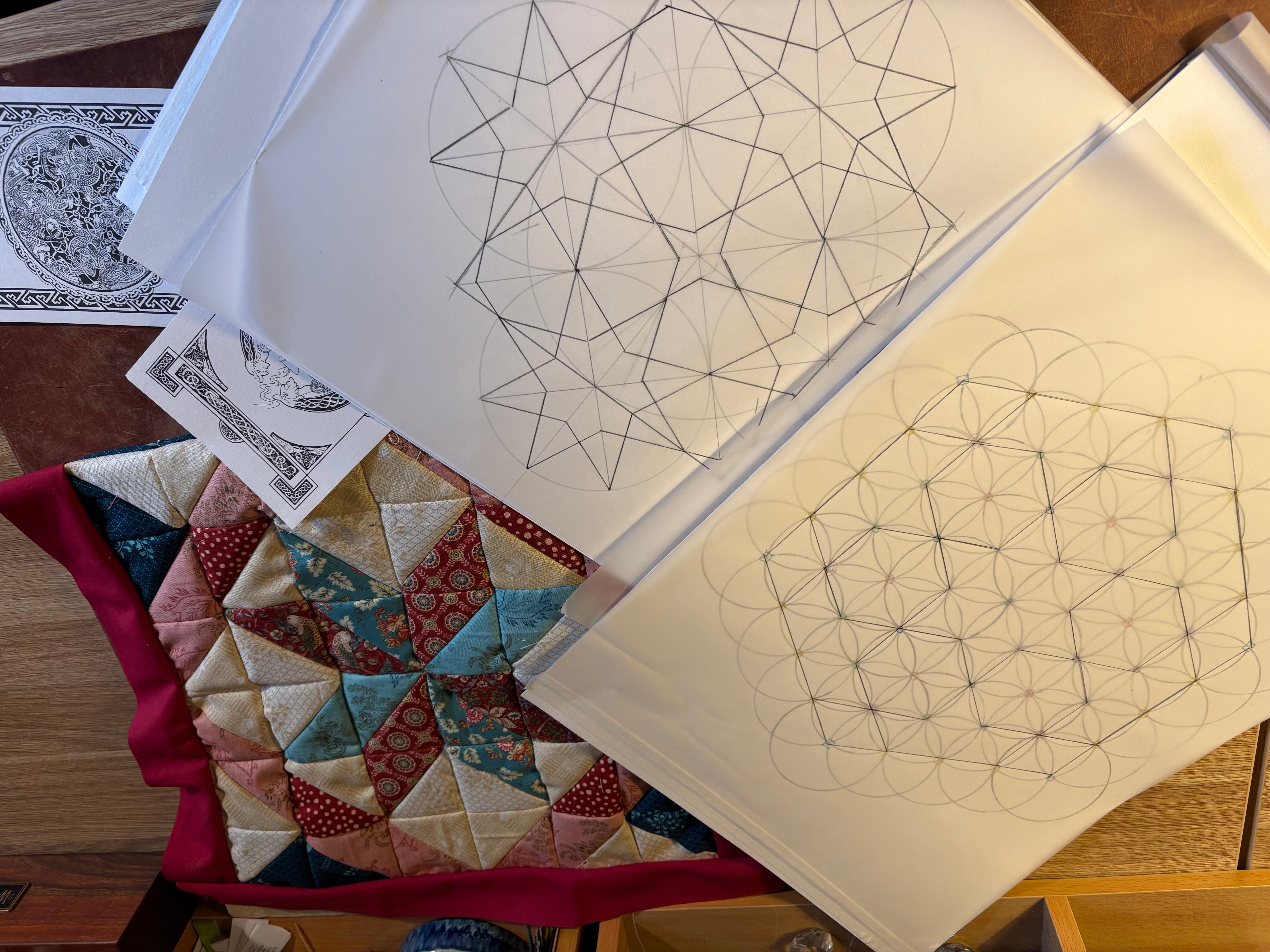
It delighted me to find that what I’ve learned from Tom, and from the many books I’ve been poring over that offer more theory and practice, combines beautifully with the extensive studies I made three decades ago in Connemara into another form of contemplative sacred geometry: the production of Celtic knotwork. I’ve found myself circling back around to 1995, an intensely creative year when I was in the throes of my first attempt to break free from corporate life: a year during which, with a bottle of black ink, a vast array of Rotring pen-nibs and many pads of graph paper, I quite literally drew myself back into life. (This was the year that I first immersed myself fully in the study of Irish mythology, and the drawings I made were immersed in it too. All of it steeped in the land I inhabited – and that’s how I began to conceive of myth as manifestation, not merely as idea.) It amused me too to realise that the craft of traditional patchwork quilting that I also took up at the same time uses many of these same patterns. Hexagons, triangles, diamonds and six- and eight-pointed stars: the same kind of tessellations, using the same kind of shapes, using colour and pattern to pick out new themes and correspondences. Whether with ink and paper or with cloth and thread, then, we draw down the sacred and through it we perceive the magic that underlies the everyday.
Along with many other marvels and wonders both theoretical and practical, all of this will form part of the curriculum (both online and with a live event or two at Broughton) that I’ll be launching in two weeks’ time. Because what I’m wholeheartedly wishing for with this new project I’ve named Nostos (an old Greek word which means homecoming) is that everyone who joins us should come to appreciate the beauty as well as the sanity inherent in returning to philosophy as a way of life. A way of life which carries in its wake a simple but beautiful, non-dogmatic, ancient form of spirituality from the oldest Western traditions, and one that insists on us belonging to a purposeful, creative, animate cosmos – which loves to dance.
Exciting times ahead – so do look out for my newsletter on March 7, and I hope afterwards to see some of you joining us in our online community of the curious (and perhaps our live retreats) at Nostos.
Good morning Sharon, there must be something in the air! I now own my first canvas labyrinth, around 18 foot diameter, and will be leading a Labyrinth Walk in Cornwall on March 1st. The Labyrinth is an ancient form of sacred geometry, combining the circle and the spiral form, and walking with an open mind and heart can connect with the space of 'All that is'. it is a simple walking meditation, but very powerful.
I am very excited about Nostos and for your discovery Sharon (well, not yours exactly but hopefully you know what I mean) and can’t wait to hear more.
I love seeing the fractal patterns of life all around me and have made patchwork quilts for years.
I have a quote but no remembering of who might have said it: Fractal flourishing: if the smallest part of a system flourishes then the whole system flourishes.
I feel we definitely need more of type of flourishing.